This one was a unit that was brought in to our workshop with the client believing there was a fault with either the battery or the Deye inverter so both came in for testing as a system. The clients installer (electrician) had tested everything on site for bad connections or blown fuses etc and he to had deemed it a fault with either the battery or inverter.
The inverter was presenting an F14 (DC over current) fault continuously when there was a power outage at the clients home, meaning exactly what the fault says, DC over current.
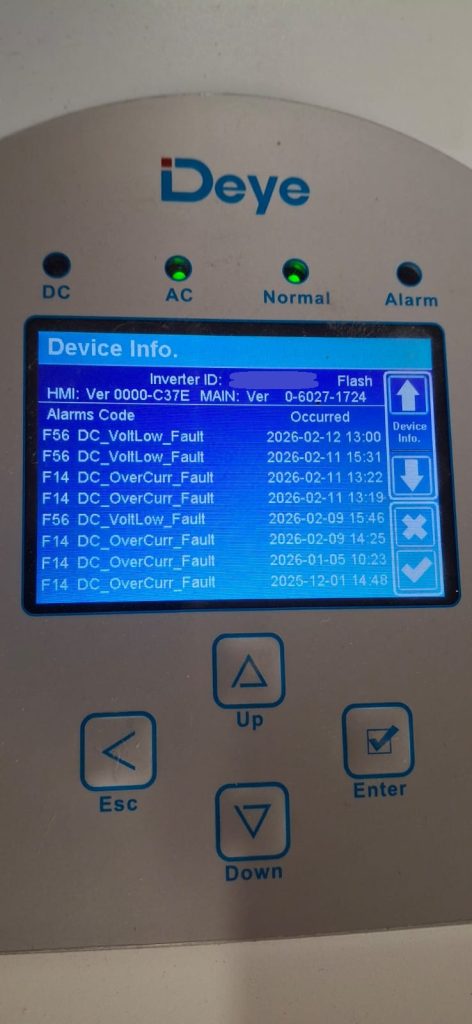
The user manual for this inverter has no mention of the F14 (DC over current) or any form of remedy for it, but quite simply, this error occurs, and will only occur if there is no grid supply to the inverter and the inverter is running exclusively off the DC power supplied to it from the battery bank.
On the battery settings page, there is a max discharge and max charge current setting. This should always be set to what your battery manufacturer recommends for max charge and discharge currents (bear in mind, this can be multiplied by the number of batteries installed in the system. So if recommended is 50A charge current, if there are 2 batteries on site, this can be multiplied by 2 to 100A. These values are overridden though by the batteries BMS if this is being used).
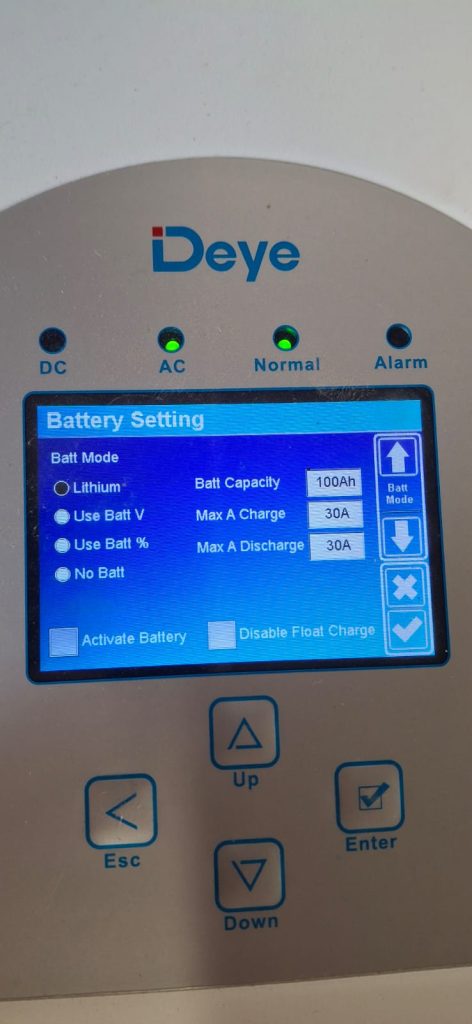
In this case the setting for maximum discharge was set at 50A (reduced to 30A for simulation purposes), this is the maximum current the inverter is allowed to draw from the battery. If this value is ever exceeded in an off grid scenario, the F14 fault will be triggered (this being synonymous with the clients reported fault).
So if the load ever exceeds 2.5kW (50A x 51.v) in an off grid environment, this will exceed the 50A the inverter is told it’s allowed to draw and the F14 fault will occur. If grid supply was available, the inverter would use the 50A from the battery and supplement the rest from a grid supply.
Below is a video simulation of the actual fault occurring along with how adjusting the max discharge current to match what the load requires solves it.
When setting the max charge and discharge currents you will need to follow accordingly to the battery manufacturers specifications. While most batteries are rated at 1C (ie 100A discharge current from a 100Ah battery), its recommended to use a 0.5C current (ie 50A from a 100A battery). So you need to make sure before setting your charge and discharge currents that your battery bank allows for these (refer to the section where the rated discharge currents are multiplied by the number of batteries in the system.