This was an interesting fault on an ATESS PCS250 system which also has generator integration. The client had been complaining for quite some time that the generator automation wasn’t working, and from what I could gather, the site had basically been operated in manual mode almost since the system was commissioned. I don’t know much about the history of this particular site, but it was believed that the automation had worked at some point. The generator itself was also not connecting to the ATESS PCS to charge the batteries.
This is particularly important on this site because the PV is AC coupled only. If the PCS were to shut down during an extended grid outage because the batteries had reached a low voltage, it would no longer be able to provide an AC supply to the PV inverters. This means that even if there was plenty of sun available, the PV inverters wouldn’t be able to generate anything until the PCS could be brought back online.
The call-out actually came about while the site was already in a grid loss condition. The facility manager who would normally start the generator was unavailable, so the facility was completely without power. The first priority was obviously to get the power back on, so the generator was started manually and the facility was brought back online.
Once we had power restored, I could start looking at why the generator automation wasn’t working.
I’d never worked on this particular site before, so the first thing I wanted to do was understand exactly how everything was connected. The basic reticulation is as follows:
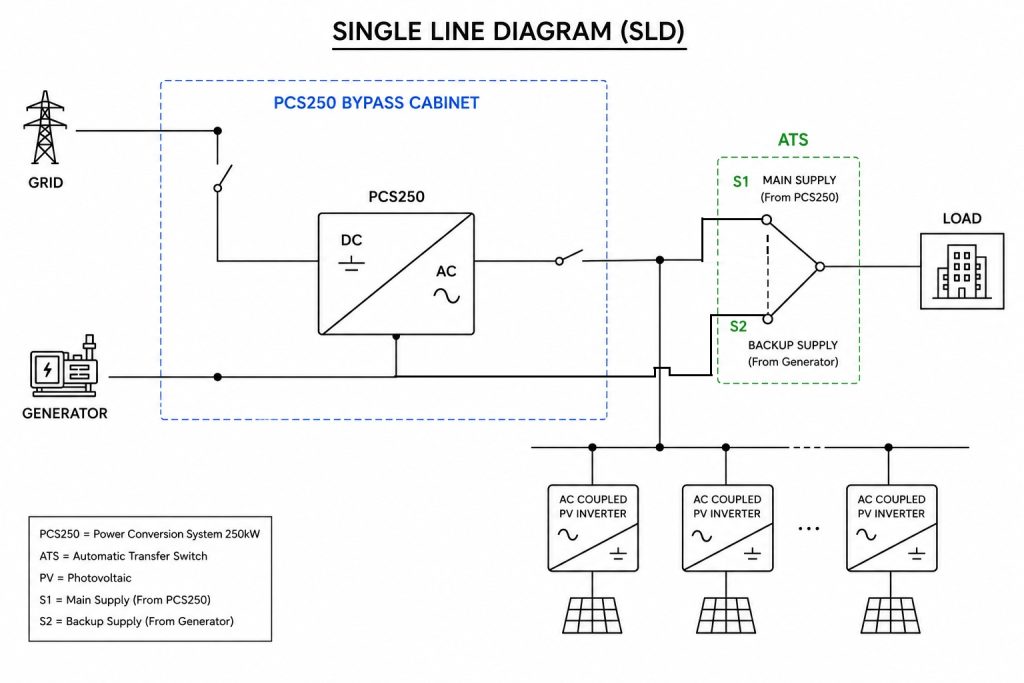
The grid supplies the PCS directly, while the generator is connected through the ATS on S2. The PCS load output goes into S1 of the ATS.
The idea is that the PCS normally supplies the load through S1. If the PCS is unavailable, the ATS can transfer the load to the generator on S2. The ATESS bypass cabinet also allows the PCS to be bypassed if required. Once I understood the reticulation, I could start working through the system one part at a time. The first thing I found was that the generator breaker inside the ATESS bypass cabinet was switched off.
This meant that although the generator was running, the PCS wasn’t actually receiving any power from it and therefore couldn’t use the generator to charge the battery bank. I switched the breaker on and the PCS immediately had access to the generator supply and could start charging the batteries. But there was still something that didn’t look right.
While the PCS was charging the batteries from the generator, it wasn’t showing any load. This turned out to be because the ATS was still sitting on S2, which is the generator supply. I checked the DeepSea controller and noticed that it was only seeing voltage on one of the three phases on S1.
This didn’t make sense because S1 is supplied from the PCS load output, so I measured the voltage directly at the PCS load output bus. All three phases were present and the voltages were what I’d expect to see. There was certainly enough voltage available for the ATS to switch back to S1. I then measured the voltage again directly at the DeepSea controller and got the same result – only one phase was being detected.
So I started working backwards from the controller. This is where I found something rather strange. Two of the fuses supplying the voltage sensing from the bus to the DeepSea controller had been removed. Unfortunately, there was no information available as to why these fuses had been removed. I can only assume they had been pulled at some point to prevent the ATS from switching to S1, but I can’t say that for certain.
Whatever the reason, the result was that the DeepSea controller couldn’t correctly see all three phases on S1. I restored the two fuses and, once the controller could see the three phases correctly, the ATS switched from S2 back to S1. At this point we had the system doing what it should.
The generator could supply the PCS, the PCS could charge the batteries and the PCS could supply the load while the generator was running. The next thing I wanted to check was whether the ATESS PCS was actually sending the generator start and stop signals correctly. To test the generator stop function, I lowered the generator off SOC (the “SOC Up Limit”) until it was close to the battery’s current SOC.
Once the battery reached that SOC, the generator didn’t stop. I then switched the generator off manually and performed the same test in the opposite direction. I lowered the generator start SOC (the “SOC Down Limit”) until it was close to the current battery SOC and waited for the battery to reach that level. Again, the generator didn’t start and there was no start request being displayed on the DeepSea controller.
So now I needed to establish whether the PCS was actually sending the start signal. The generator start/stop output from the PCS is a relay, so I checked continuity across the two conductors going to the generator controller. The PCS was sending the signal. This meant the problem wasn’t with the PCS sending the request. Something further along the chain was preventing the generator controller from responding to it.
I connected my laptop to the DeepSea controller and checked its configuration. This is where we found another problem. The controller had been configured for Loss of Mains (LOM) starting rather than accepting a remote start request from the PCS. So although the PCS was sending the correct start signal, the DeepSea controller wasn’t configured to respond to it. This explained why the automatic generator start wasn’t working. The controller would need to be reconfigured to accept the remote start signal from the PCS.
I left this configuration unchanged because the generator controller is managed by the generator company and we don’t make configuration changes to their controllers ourselves. At this point we had identified one of the reasons the generator automation wasn’t working. But I still wanted to see what would happen during an actual PCS shutdown. I decided to allow the PCS to run down into shutdown so that we could test the exact situation that had originally caused the problem on site. Once the PCS shut down, the generator did actually receive a start request and started up.
So the currently configured Loss of Mains start function was working under those conditions. However, another problem appeared. The ATS was in automatic mode, but it wouldn’t switch over to S2. It attempted to switch, but never actually moved into a latched state. I then tried putting the ATS into manual operation and switching it to S2 manually. It still wouldn’t switch. At this point, the S2 switching mechanism appeared to be faulty and would need to be repaired or replaced.
What initially appeared to be one problem – “the generator automation doesn’t work” – actually turned out to be several different issues. The first was that the generator breaker in the ATESS bypass cabinet was switched off, meaning the PCS couldn’t use the generator to charge the batteries. We then found that two voltage-sensing fuses to the DeepSea controller had been removed, meaning the controller couldn’t correctly detect all three phases from the PCS output and the ATS wasn’t transferring correctly.
We also found that the DeepSea controller had been configured for Loss of Mains starting rather than remote starting from the PCS. And finally, when testing the system under an actual PCS shutdown condition, the S2 switching mechanism on the ATS would not transfer, even when commanded manually. So there are currently two things that need to be addressed before the site can be considered fully automatic:
- The DeepSea controller needs to be reconfigured to accept the ATESS PCS remote start signal.
- The S2 switching mechanism on the ATS needs to be repaired or replaced.
Once those two issues have been resolved, the other testing we’ve done indicates that the system should be capable of operating correctly in automatic mode.
This was a good example of why I think it’s important to understand the complete system reticulation before starting to troubleshoot a complicated system. There were several different pieces of equipment involved here, the ATESS PCS, bypass cabinet, ATS and DeepSea generator controller and a problem with any one of them could quite easily present itself as simply “the generator automation isn’t working.”
If I had started by assuming the problem was with the ATESS generator control, I could easily have spent a lot of time looking in the wrong place. Instead, by working through the system from the power sources to the load and then testing the control signals separately, we were able to identify several independent problems that were preventing the system from operating as intended. The other important thing is that we didn’t just assume that fixing the first problem meant the system was fixed. Each part was tested again after the previous problem was resolved.
That’s what eventually allowed us to get to the point where we could say exactly what was still preventing full automatic operation.